School Writing Workshop: The Last Page
Last month I did a series of writing workshops with elementary students at a local Edmonton School during a 2-week artist residency. Throughout my visit, each class created a different story, collectively ending up with a series of 11 fully illustrated stories.
One my my favourite stories (actually, they’re all my favourites), is this one written with one of the grade 6 classes. Scroll down to read a bit of the backstory ad see why I love this on so much.

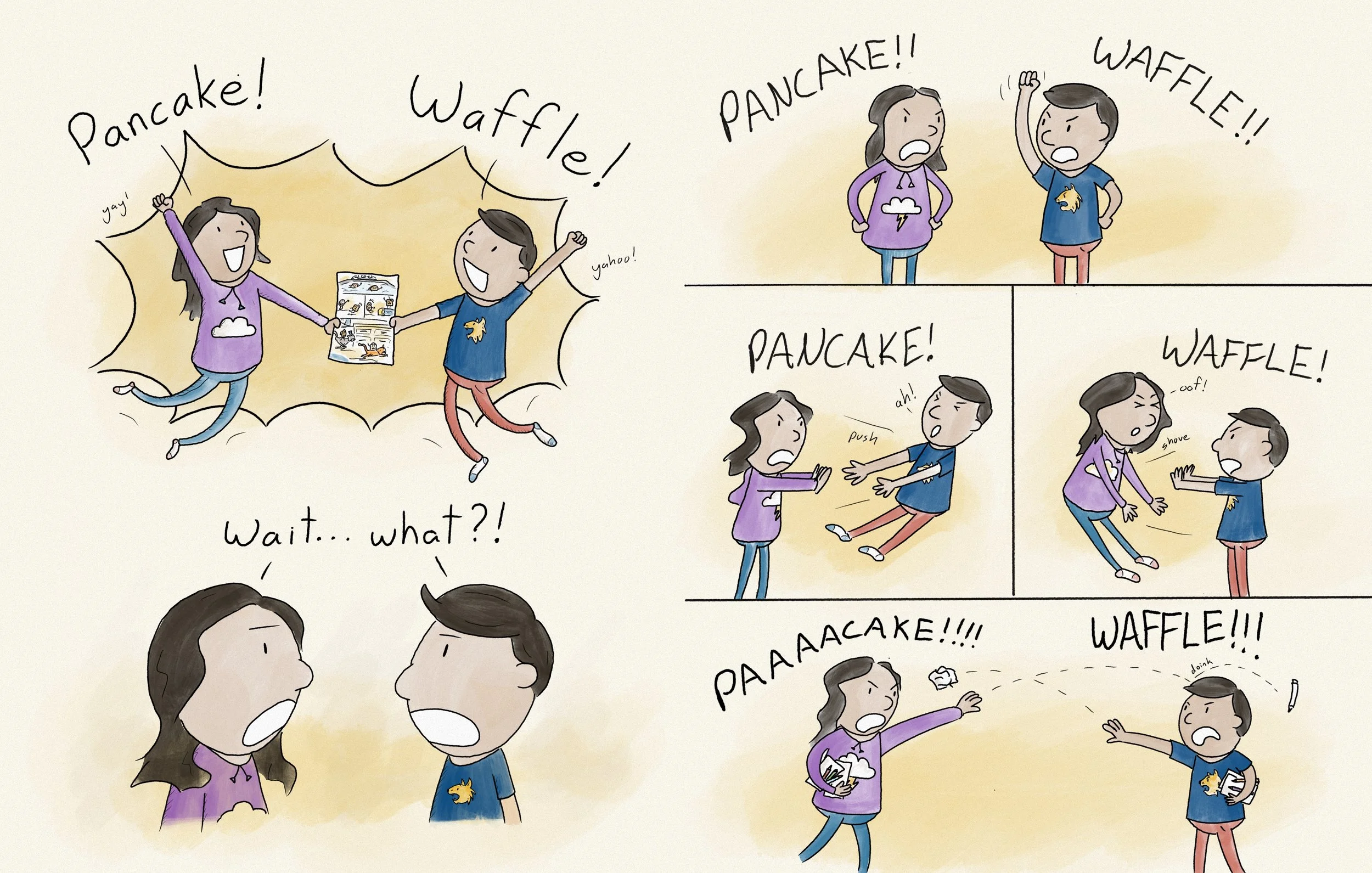

Last year I did a few writing workshops at this same school, where the students and I came up with an outline for a story, including introduction, the plot points, and the ending, and then I illustrate one page for the story. One story which has become somewhat legendary was Pancake vs Waffle, a story about two breakfast foods competing to see who is the best while making a big mess of themselves (and the kitchen) in the process. The page I illustrated featured pancake and waffle racing around the kitchen riding on cats. In the end, the family comes down for breakfast, and when they see pancake and waffle they say ‘Eww, we’ll just have crepes”.
For this residency, I gave this class the honour of writing the last story for the collection, and I thought it would be a cool meta thing to call it ‘The Last Page’. Other than the title, I had no other prompts for the students. Little did I realize that we would eventually end up paying homage to a piece of the school’s history, and writing a story about two siblings writing the story of Pancake vs Waffle.
This is what I love about doing these workshops; when I showed up last year, I never would have dreamed that I’d be drawing a pancake and a waffle riding cats, and when I showed up this year, I never would of guessed that I’d be seeing pancake and waffle yet again.
For more information about school writing workshops in the Edmonton area (and beyond), click here.
My First Colouring Wall

I was recently commissioned to make a colouring wall for the Calgary and Edmonton Renovation shows.
I loved the idea of creating a piece of art that would ultimately become a collaborative, interactive art project for kids, a piece that would evolve as people added their contributions.
Since it was for a renovation show, I came up with a colouring wall design of a messy workbench fill with tools, toys, and trinkets (partly inspired by my own workbench).

The biggest challenge was dealing with the size of the illustration. It was to be 4 ft x 8ft. A large illustration like this really slows down my drawing app, and greatly reduces the namer of layers I can create. I ended up making the sketch at a smaller size, and then doing the final illustration in two parts.
Another challenge was coming up with all of the things to add to the bench. I wanted there to be a lot of little things for kids to colour. I started with the tools, and then slowly filled in the spaces in between (a few of my favourite things I added are the treehouse illustration, Fischer Price toys, stickers, bird poster, and the stegosaurus).
I absolutely loved seeing kids interacting with the wall and seeing the collaborative transformation of the piece.
If you’re interested in creating an interactive art project for your event, I encourage you to consider a colouring wall. It is a fun and rewarding way to bring an audience together. And if you have questions about the creative process, or would like to commission a piece from me, feel free to use the contact page to get in touch!

Wings of Wisdom: IB Learner Profile posters for St. John's School
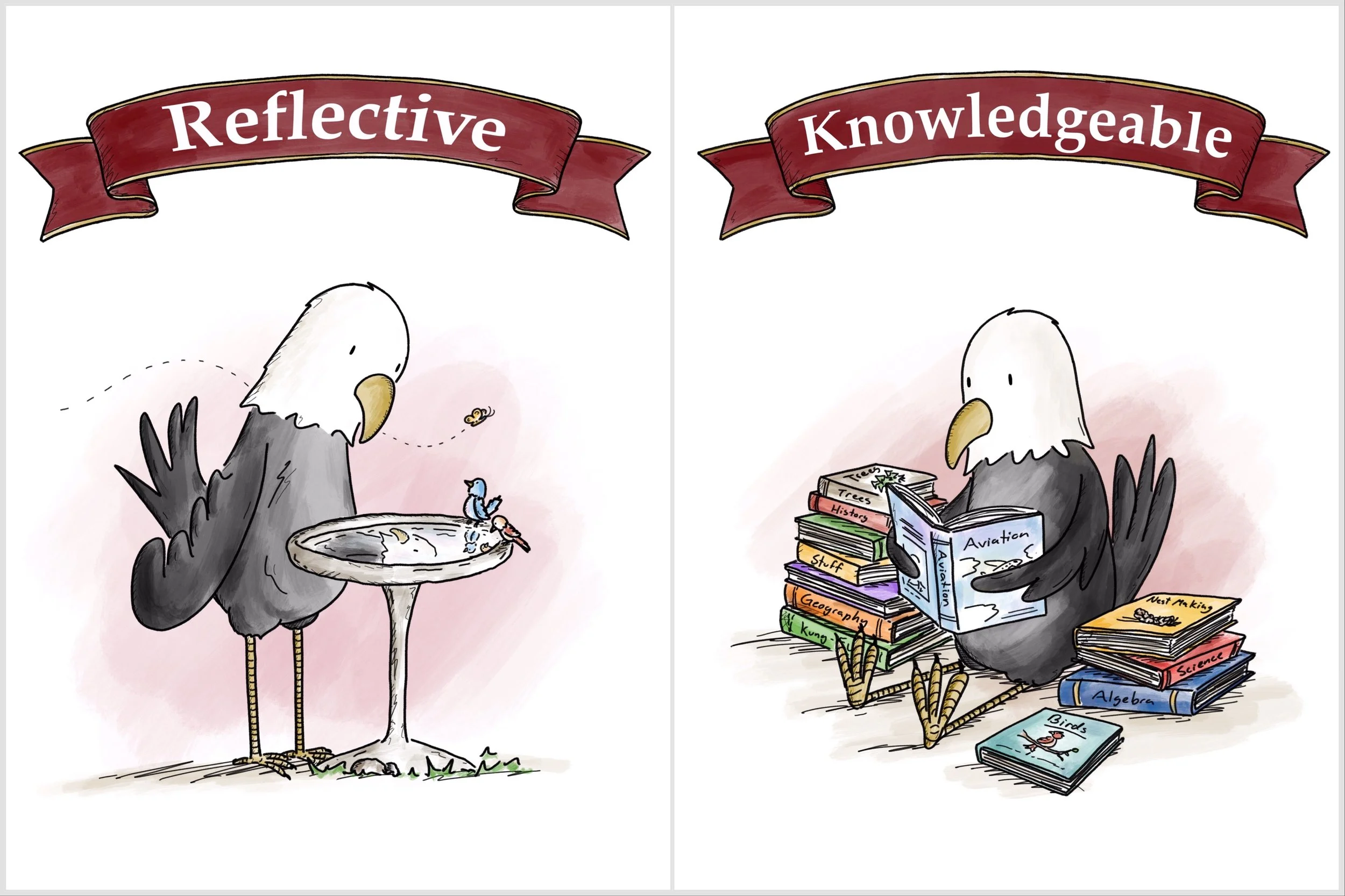
This year I had the delightful opportunity to create a series of IB Learner Profile posters for St. John's School in Vancouver. With their spirited bald eagle mascot as the visual guide, each poster set out to exemplify the core attributes of the International Baccalaureate Learner Profile. This creative journey was a joyous exploration of melding education with art. And the best part?
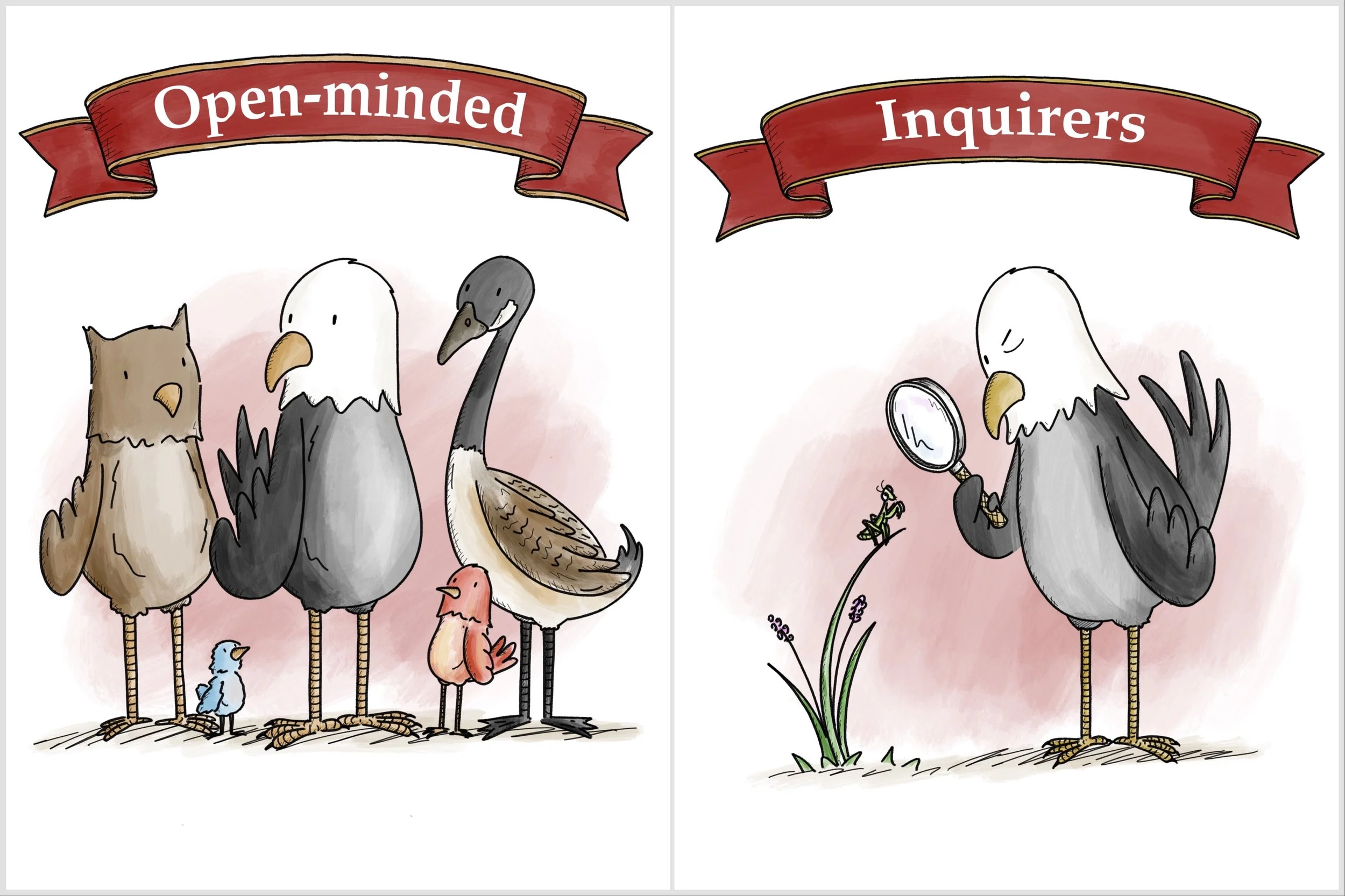
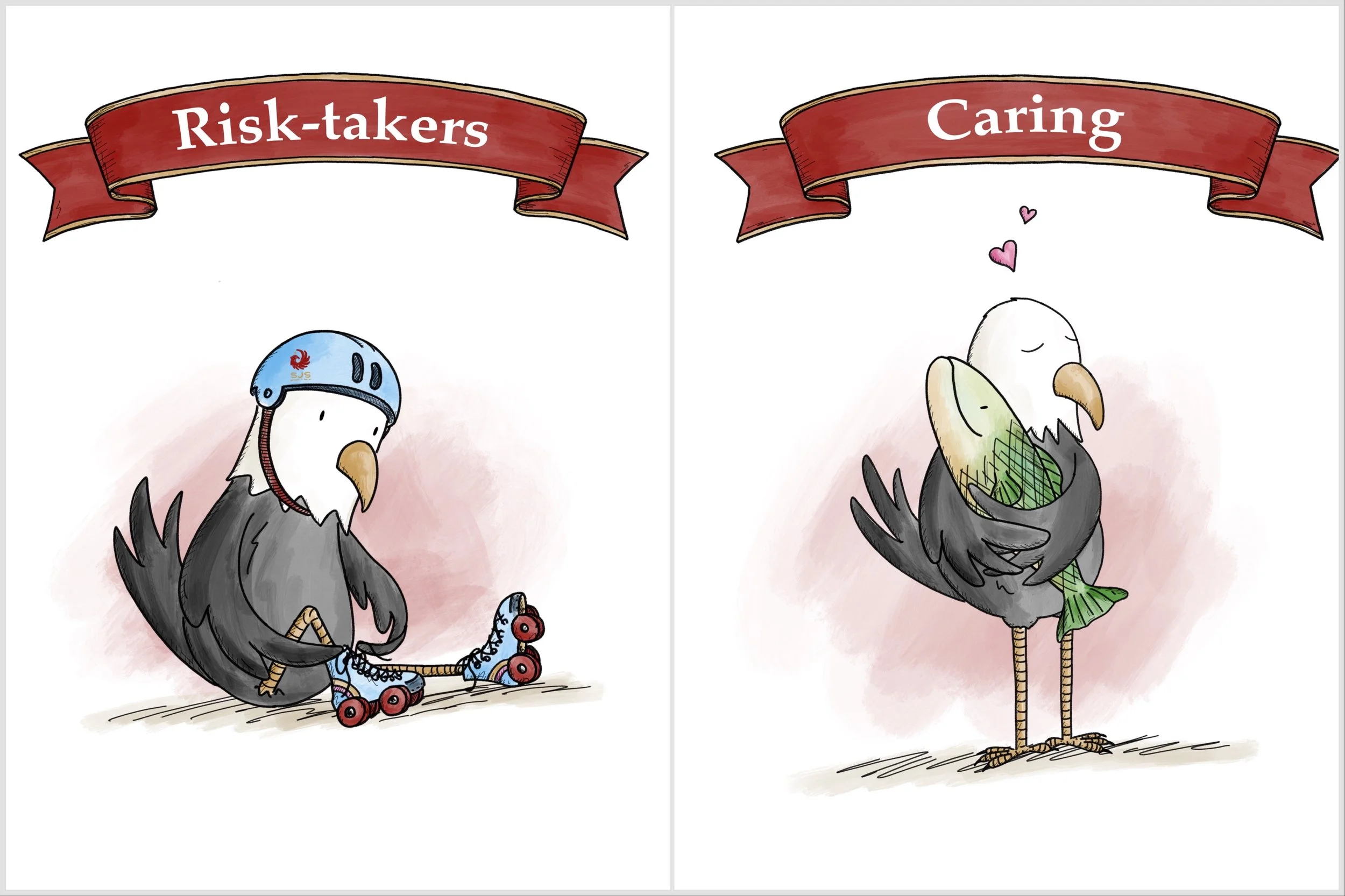
Let's take a moment to ponder the significance of using mascots. Much like a school flag fluttering in the wind, a mascot becomes a symbol that unites a community. There is a familiarity in these symbols, which have the power the ability to immediately connect to the school community. I love that students get to see their school mascot in a different style, showing the playfulness that is possible in everyday things.


I get a lot of enquiries from schools asking about creating their own set of posters, and its always flattering a exciting. If you’re part of a school and would love to see some inspiring custom artwork on your walls, please get in touch and let’s chat. Another example of fun IB posters I did for a different school can found here.
Downloadable IB posters are also available in my Etsy shop here.
Festive Fables Vol.1

This year, as the hustle and bustle of the holiday season took over, I took a creative detour from my annual illustrated advent calendar. Instead of 25 illustrations, I came up with concepts for ‘classic Christmas stories’, and created the cover illustration. So in leu of the Annual Land of Le Beef Christmas Advent Calendar, I present, ‘Festive Fables: 4 stories from the North Pole’. I’ve included a little blurb about each story, however Educators are welcome to use these illustrations and titles as creative writing prompts, and see what wonderful stories their students create.

Festive Fable #1: The Ninja Elves
Every year Santa Claus visits homes all over the world, delivering toys and Christmas cheer, but what most people don’t know (including Santa himself), is that Santa is hopelessly clumsy! He can barely go into a home without knocking over a tree, stepping on a cat’s tail, or accidentally smashing a priceless vase. Enter ‘the Ninja Elves’, Christmas’ silent saviours. Every holiday season this covert squad of stealthy elves silently follow the big guy around to every home, preventing countless catastrophes with every lightning fast move, ensuring a safe and silent night for all.

Festive Fable #2: Christmas through the Ages
Take a journey through time as the North Pole’s oldest elf shares stories of Christmases past, from ancient Rome to the Renaissance, and all the way back to the Stone Age and beyond. What kind of wrapping paper did they use in the Bronze Age? Where did cavemen hang their stockings? What did a stegosaurus want for Christmas? Every page is a yuletide delight that will keep you on the edge of your tinsel trimmed toes.

Festive Fable #3: The Christmas Beavers
The North Pole toy shop has changed a lot over the years; where there used to be a simple workbench and a few tools, there are now big machines, electronics, and even a few robots. But if step outside, walk through the forest, past the field, and follow the river down a little ways, you might see a little dome made of sticks, and you might hear the soft sounds of sawing and tinkering. Inside you will find the Christmas beavers. While toys become more and more convoluted, these beavers continue a tradition and handcrafting little wooden toys. They put a lot of love into each piece they make, and because each one takes so much time, they only give them to extra special girls and boys. So this Christmas, if find a wooden treasure under the tree, you will know that the Christmas beavers made it just for you.

Festive Fable #4: The Elf-Napping of Connor McDavid
Frustrated by their repeated losses in the North Pole Hockey Tournament, a team of elves hatch a bold plan to kidnap NHL superstar Connor McDavid. Though initially hesitant, McDavid is eventually persuaded to coach the elves, and their skills quickly improve under his guidance. But as they train, the elves discover that winning isn’t everything, and that the true spirit of hockey lies in the camaraderie and sportsmanship they develop along the way. With their newfound sense of teamwork, they approach the tournament with a fresh outlook and renewed determination, ready to show the world what they’re made of - not just as players, but as a team united in friendship and fun!
Happy Holidays :)
Darren
The Importance of Story Writing for Ages 4-6
Writing stories is an important tool for children's development. It encourages creativity, imagination, and critical thinking as they construct narratives and explore new worlds. Although the benefits crafting stories universal, different age groups encounter distinct challenges, and approach story writing uniquely. For the littlest ones, like kindergarten and grade 1, stories become delightful adventures, stimulating creativity and vocabulary acquisition. As children progress to grades 2-4, they embrace structure and character development, refining their storytelling skills. By grades 5-6, they delve into more complex narratives, fostering critical thinking and emotional intelligence.
In this first of a series of posts we’ll take a closer look at what story writing looks like for ages 4-6.

Why Story Writing for Ages 4-6 Matters
1.Enhances communication skills: Writing stories helps young students develop basic vocabulary and sentence structure, laying the foundation for effective communication.
2. Stimulates creativity: Storytelling encourages imaginative thinking and helps young children express their ideas and experiences.
3. Builds fine motor skills: The physical act of writing stories with pencils or crayons promotes fine motor skill development.
4. Boosts confidence: Creating stories allows young students to share their ideas and thoughts, boosting their self-confidence and sense of accomplishment.
Common Challenges that Young Writers often Face
By understanding the specific challenges that students may face at different age levels, educators can provide targeted support, guidance, and strategies to help students overcome these obstacles and grow as writers.
1. Limited vocabulary: Young students may struggle to find and use a wide range of words to express their ideas.
2. Sentence structure: Formulating complete sentences and using correct grammar may be challenging for early writers.
3. Spelling and phonics: Basic spelling and phonetic skills are still developing, which can make writing accurately a challenge.
4. Focus and attention span: Maintaining concentration for extended periods of writing may be difficult for young students.

Fostering Young Creativity: Encouraging Storytelling in 4-6 Year Olds
Encouragement is crucial to help students persevere and continue writing, regardless of their age group. Here are some strategies that parents, educators, and workshop leaders can use to help students build confidence and cultivate a lifelong love for writing.:
1. Provide positive feedback: Acknowledge their efforts and celebrate their accomplishments, emphasizing their creativity and ideas.
2. Offer praise for specific elements: Highlight specific details in their writing, such as a well-described character or an interesting event.
3. Keep it playful: Make writing enjoyable and fun by incorporating games, storytelling, and imaginative activities into the process.
4. Use visual aids: Incorporate visuals like illustrations, picture prompts, or storyboards to stimulate their imagination and provide inspiration.
Tales From Early Years: What to Expect in Ages 4-6 Writing
Here is a general overview of what one might expect from this age group:
1. Basic sentence structure: Kindergarten and grade 1 students may use simple sentences with limited complexity. They might rely on repetitive phrases or familiar story patterns.
2. Imaginative themes: Young writers in these grades often gravitate towards imaginative and fantastical themes, such as talking animals, magical adventures, or imaginary friends.
3. Emotions & experiences: Kindergarten and grade 1 students often draw inspiration from their personal experiences and emotions. Encourage them to express their feelings and incorporate relatable moments into their stories.
4. Simple plot structure: Stories from these grades may follow a basic structure of beginning, middle, and end. Help them identify characters, setting, problem, and resolution.
Young Minds in Motion: Story Writing Prompts for Ages 4-6
1. Imagine you found a magical object in your backyard. Write a story about what happens when you touch it.
2. Write a story about your favorite animal going on an adventure.
3. Create a story about a day at the beach using only pictures.
4. Write a story about a friendly monster that lives in your closet.
5. Imagine you could fly like a bird. What would you do? Write a story about your amazing adventure.
6. Write a story about a talking animal that visits your school.
7. Imagine you have a magic wand that can grant three wishes. What would you wish for?
8. Write a story about a lost toy that goes on a journey to find its owner.
9. Create a story about a silly character who loves to tell jokes.
10. Imagine you could visit any place in the world. Write a story about your incredible trip.
Welcome to the Beef Blog
it's a fun place

-
2026
- Feb 12, 2026 Gold Bar School Artist Residency Feb 12, 2026
-
2024
- Jul 24, 2024 32 Illustrated Kids Jokes Jul 24, 2024
- Jun 19, 2024 My Favourite Picture Book About Death Jun 19, 2024
- Apr 3, 2024 School Writing Workshop: Moon Trees Apr 3, 2024
- Mar 27, 2024 School Writing Workshop: The Amazing Tube Mar 27, 2024
- Mar 20, 2024 School Writing Workshop: The Last Page Mar 20, 2024
- Jan 14, 2024 My First Colouring Wall Jan 14, 2024
-
2023
- Dec 29, 2023 Wings of Wisdom: IB Learner Profile posters for St. John's School Dec 29, 2023
- Dec 29, 2023 Festive Fables Vol.1 Dec 29, 2023
- Aug 2, 2023 The Importance of Story Writing for Ages 4-6 Aug 2, 2023
- Mar 19, 2023 Lunchbox Jokes Mar 19, 2023
- Mar 19, 2023 The IB Learner Profile Classroom Posters Mar 19, 2023
- Feb 1, 2023 Library Finds - part 3 Feb 1, 2023
-
2022
- Jul 2, 2022 IB Learner Profiles Posters Jul 2, 2022
- May 29, 2022 Library Finds - part 2 May 29, 2022
- Apr 24, 2022 What Every Artist Website Should Include Apr 24, 2022
- Mar 19, 2022 How Forest Animals Can Use Blogging for Business Mar 19, 2022
- Feb 22, 2022 Library Finds - part 1 Feb 22, 2022
- Feb 19, 2022 LinkedIn Feb 19, 2022
-
2018
- Oct 26, 2018 Morning Tea Oct 26, 2018
- Oct 26, 2018 the International Baccalaureate - Key Concepts posters Oct 26, 2018
- Oct 25, 2018 the IB Approaches to Learning Oct 25, 2018
- Oct 19, 2018 Happy Birthday Maddy Oct 19, 2018
-
2017
- Oct 19, 2017 Bees! Oct 19, 2017
- Mar 27, 2017 Eastside Flea (my first market experience) Mar 27, 2017
-
2016
- Dec 27, 2016 the 4th Annual Land of Le Beef Christmas Advent Calendar Dec 27, 2016
- Oct 26, 2016 Maddy's Favourite Toys Oct 26, 2016
- Sep 24, 2016 IB Learner Profile Posters Sep 24, 2016
- Aug 22, 2016 Dear Diary... Aug 22, 2016
- Mar 23, 2016 Goldilocks & the Three Bears Mar 23, 2016
- Mar 4, 2016 Three Blind Mice Mar 4, 2016
- Mar 3, 2016 Bob the Rabbit Mar 3, 2016
- Feb 29, 2016 Storybook Sketches Feb 29, 2016
- Feb 8, 2016 Year of the Monkey Feb 8, 2016
- Feb 1, 2016 A Crab with a Straw Feb 1, 2016
- Jan 8, 2016 Dear Diary: Chapter 5 Jan 8, 2016
-
2015
- Dec 25, 2015 The 3rd Annual 2015 Land of Le Beef Christmas Advent Calendar: Hollywood Edition Dec 25, 2015
- Nov 25, 2015 Dear Diary: Chapter 4 Nov 25, 2015
- Oct 22, 2015 Another Six Random Things Oct 22, 2015
- Oct 19, 2015 the Adventures of Maddy and Alphapup Oct 19, 2015
- Oct 8, 2015 Six More Things Oct 8, 2015
- Oct 8, 2015 the Buildings of Hong Kong Oct 8, 2015
- Sep 20, 2015 Six Things Sep 20, 2015
- May 5, 2015 Doodles & Stuff - a Javier Perez Inspired Class Project May 5, 2015
- Apr 17, 2015 Octographer Apr 17, 2015
- Apr 16, 2015 32 Bottles of Beer | part 2 Apr 16, 2015
- Mar 30, 2015 Hey Diddle Diddle Mar 30, 2015
- Mar 5, 2015 What a Wonderful World Mar 5, 2015
- Feb 24, 2015 32 Bottles of Beer | part 1 Feb 24, 2015
- Jan 1, 2015 The 2014 Second Annual Land of Le Beef Christmas Advent Calendar: Classic Toys Edition Jan 1, 2015
-
2014
- Nov 24, 2014 It's Jibo! Nov 24, 2014
- Oct 31, 2014 It's a Halloween Spooktacular Oct 31, 2014
- Sep 26, 2014 Cartooning 101 Sep 26, 2014
- Sep 2, 2014 That's Not a Knife Sep 2, 2014
- Sep 2, 2014 The Couch and the Lamp Sep 2, 2014
- Aug 12, 2014 Research and Development Aug 12, 2014
- Jun 20, 2014 Coming Soon to a Womb Near You... Jun 20, 2014
- May 21, 2014 Mother's Day May 21, 2014
- May 2, 2014 A Fine Feathery Mess May 2, 2014
- Apr 3, 2014 Sizzling Apr 3, 2014
- Apr 3, 2014 Evernote Apr 3, 2014
- Mar 27, 2014 Broken Pig Mar 27, 2014
- Mar 26, 2014 When life gives you lemons Mar 26, 2014
- Mar 25, 2014 Every dog has its day Mar 25, 2014
- Feb 26, 2014 Breakfast Cereals Feb 26, 2014
- Feb 19, 2014 Under the Sea Feb 19, 2014
- Feb 14, 2014 A Very Beefy Valentines Day Feb 14, 2014
- Feb 6, 2014 Year of the Horse, 2014 Feb 6, 2014
- Feb 3, 2014 Horsing Around Feb 3, 2014
- Jan 23, 2014 Gratitude - Staedtler and Uni-Ball Jan 23, 2014
- Jan 17, 2014 the Beef Jan 17, 2014
-
2013
- Dec 25, 2013 Merry Christmas Dec 25, 2013
- Dec 12, 2013 Snowmen! Snowmen! Snowmen! Dec 12, 2013
- Dec 1, 2013 the first annual Land of Le Beef 'Christmas Advent Calendar' Dec 1, 2013
- Nov 28, 2013 a fish out of water Nov 28, 2013
- Oct 31, 2013 Halloween Monster Spectacular Oct 31, 2013
- Oct 7, 2013 birthday gecko Oct 7, 2013
- Sep 30, 2013 Woodland Classroom Animals Sep 30, 2013
- Sep 23, 2013 International Talk Like a Pirate Day Sep 23, 2013
- Sep 16, 2013 the Montessori Academy Sep 16, 2013
- Sep 9, 2013 me and my can-opener Sep 9, 2013
- Aug 26, 2013 woodland murals Aug 26, 2013
- Jun 9, 2013 art adventure day! Jun 9, 2013
- Jun 9, 2013 incoming Jun 9, 2013
- May 17, 2013 Yellow Brick Road May 17, 2013
- May 10, 2013 Awkward May 10, 2013
- May 6, 2013 dinner for two May 6, 2013
- Apr 30, 2013 a royal flush Apr 30, 2013
- Apr 29, 2013 send in the clowns Apr 29, 2013
- Apr 24, 2013 Rocky XIII Apr 24, 2013
- Apr 17, 2013 the 4 food groups Apr 17, 2013
- Apr 8, 2013 the thunder from down under Apr 8, 2013
- Apr 4, 2013 I love the smell of easter in the morning Apr 4, 2013
- Mar 24, 2013 hot potato Mar 24, 2013
- Mar 17, 2013 a st. patrick's day extravaganza Mar 17, 2013
- Mar 11, 2013 a fresh take on an old classic Mar 11, 2013
- Mar 6, 2013 what's new, pussy cat? Mar 6, 2013
- Mar 4, 2013 do the harlem shake Mar 4, 2013
- Feb 26, 2013 warm-hearted tickle machine Feb 26, 2013
- Feb 21, 2013 why can't we all just get along? Feb 21, 2013
- Feb 15, 2013 birthday buddies Feb 15, 2013
- Feb 8, 2013 chinese new year Feb 8, 2013
-
2012
- Dec 25, 2012 holiday special Dec 25, 2012
- Oct 31, 2012 spooooooky Oct 31, 2012